Store Extra Solar Energy. Use It When You Need It Most
Battery storage lets you capture unused solar energy during the day and use it at night, during outages, or when your energy demand is highest.
SHOP BATTERIES

Why Add Battery Storage?
Your solar panels produce the most energy during the day when sunlight is available, but many of your biggest energy needs happen after sunset when solar production stops. Without battery storage, excess solar energy generated during the day may be sent back to the grid instead of being used when you need it most. A battery storage system allows you to store your unused solar energy and access it later in the evening, overnight, or during power outages. This helps you use more of the clean energy your solar panels produce, reduce your reliance on the grid, and get more value from your solar investment.
For homeowners in California, battery storage has become even more important with the introduction of NEM 3.0 (Net Energy Metering 3.0). Under NEM 3.0, solar customers receive significantly lower credits for excess energy sent back to the utility grid compared to previous net metering programs. Instead of exporting excess solar power for a smaller credit, storing that energy in a battery allows you to use it later when electricity rates are higher, especially during evening peak hours.
By pairing solar panels with battery storage, you can maximize your solar energy usage, reduce the impact of lower NEM 3.0 export rates, and maintain greater control over your home's energy. Whether your goal is lowering electricity costs, increasing energy independence, or keeping essential loads powered during outages, battery storage helps you get the most from your solar system.
☀
Use More
Solar Energy
Store excess daytime production instead of sending it to the grid.
🔋
Reliable
Backup Power
Keep essential appliances running during unexpected power outages.
⚡
Energy Independence
Reduce your reliance on utility power and increase system flexibility.
➕
Expand Your System
Add storage to an existing solar system without replacing everything.
Battery Lifecycle
Capture. Store. Use. Repeat. Reliable, renewable energy for you to use, day and night.
1
Morning
Capture Solar Energy
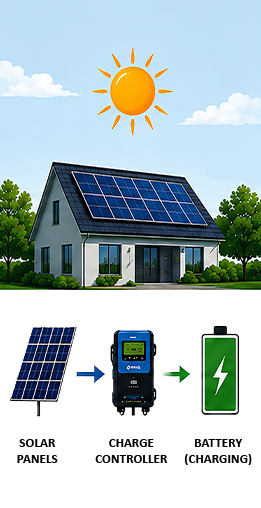
Solar Panels generate energy from the sun and charge the battery bank.
2
Afternoon
Store Maximum Power
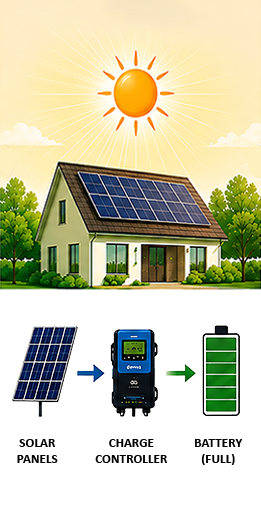
The battery bank is full charged with clean, renewable energy. Extra energy is stored for later use.
3
Evening
Power Your Home
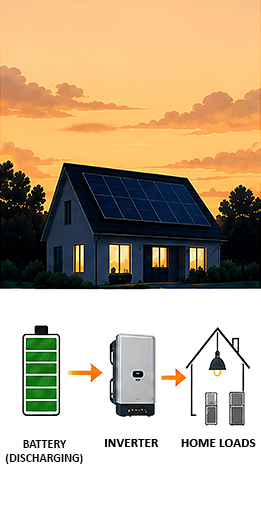
As the sun goes down, the battery begins supplying power to your home and essential devices.
4
Night
Continuous Backup Power
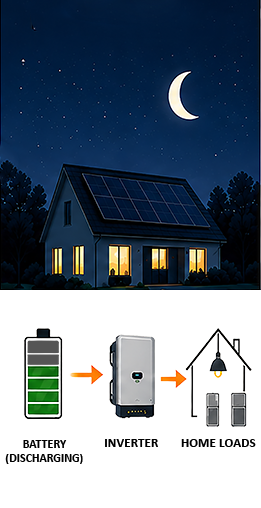
The battery continues powering your home through the night until the sun rises again.
Know Your Battery Types
Choosing the right battery is an important step in designing a reliable solar energy system. Different battery technologies offer unique advantages in areas such as lifespan, maintenance requirements, efficiency, depth of discharge, and upfront cost. Understanding the differences between Flooded Lead Acid, AGM, GEL, and Lithium batteries helps you select the right option based on your energy needs, environment, budget, and how you plan to use your system. By choosing the right battery type, you can improve system performance, maximize your solar investment, and ensure dependable power when you need it most.
Flooded
Flooded lead acid batteries, also known as wet cell batteries, are one of the most established battery technologies used for solar energy storage. They contain liquid electrolyte that surrounds the battery plates and are designed to withstand repeated charging and discharging. For solar applications, flooded lead acid batteries are a popular choice for off-grid solar systems, backup power, RVs, cabins, and other energy storage applications where reliability and lower upfront cost are important. They are available in common 6V and 12V configurations, allowing multiple batteries to be connected together to create the voltage and storage capacity a solar system requires.
-
Lower Upfront Cost
Typically costs less initially than comparable lithium battery systems.
-
Proven Solar Technology
Used for decades in off-grid solar and renewable energy systems.
-
Designed for Deep Cycling
Deep cycle models are built to handle repeated charging and discharging.
-
Wide Range of Options
Available in different voltages, capacities, and physical sizes for flexible battery bank design.
-
Recyclable
Lead acid batteries have an established recycling infrastructure.
-
Requires Regular Maintenance
Electrolyte levels should be checked regularly and distilled water added when needed.
-
Requires Ventilation
Can release hydrogen gas during charging and should be installed in a properly ventilated location.
-
Heavier Than Lithium
Flooded batteries are heavier and can require more space than lithium alternatives.
-
More Battery Capacity May Be Needed
Regular deep discharges can shorten battery life, so a larger battery bank may be needed for usable energy requirements.
-
Maintenance Affects Battery Life
Proper charging, watering, temperature control, and avoiding excessive discharge are important for maximizing service life.
AGM
AGM (Absorbent Glass Mat) batteries are a type of sealed lead acid battery designed for applications that require dependable, maintenance free energy storage. Instead of using free flowing liquid electrolyte like a flooded lead acid battery, an AGM battery holds the electrolyte in fiberglass mats between the battery plates. For solar applications, AGM batteries are commonly used in off-grid solar systems, backup power, RVs, cabins, telecommunications, and other applications where reliable battery storage and low maintenance are important. AGM batteries are sealed and do not require routine watering, making them easier to install and maintain than flooded lead acid batteries. They can also be installed in a wider range of locations because they do not require the same type of electrolyte maintenance as flooded batteries. Proper charging is still important, and the battery should always be installed and charged according to the manufacturer's specifications.
For solar systems that require dependable lead acid storage with minimal maintenance, Absorbent Glass Mat (AGM) is a practical middle ground between traditional flooded batteries and newer lithium technology.
-
Maintenance Free
AGM batteries do not require the routine watering associated with flooded lead acid batteries. This makes them a convenient option for solar systems that are difficult to access.
-
Sealed Construction
The electrolyte is absorbed into the glass mat separators rather than freely moving inside the battery. This reduces the risk of spills and makes AGM batteries easier to handle and install.
-
Good For Solar Cycling
Deep cycle AGM batteries are designed for repeated charge and discharge cycles, making them suitable for off-grid and backup solar systems when properly sized and charged.
-
Better Installation Flexibility
Because AGM batteries are sealed, they offer more installation flexibility than traditional flooded batteries. However, they still need to be installed according to the manufacturer's requirements.
-
Good Performance In Backup Application
AGM batteries can provide dependable power for critical loads when solar production is unavailable or during a grid outage.
-
Higher Upfront Cost Than Flooded Lead Acid
AGM batteries typically cost more than comparable flooded lead acid batteries. The additional cost provides the convenience of a sealed, maintenance free design.
-
Heavier Than Lithium
AGM batteries still use lead based technology, so they are significantly heavier than comparable lithium batteries.
-
Lower Usable Capacity Than Lithium
Like other lead acid batteries, AGM batteries generally should not be deeply discharged on a regular basis if long service life is desired. A larger battery bank may therefore be required to provide the desired amount of usable energy.
-
Charging Must Be Properly Controlled
AGM batteries require the correct charging voltage and settings. Overcharging can damage the battery and reduce its service life.
-
Shorter Cycle Life Than Lithium
When used in applications with frequent daily cycling, lithium batteries can generally provide more cycles and a longer service life than AGM batteries.
GEL
GEL batteries are a type of sealed lead acid battery that uses a silica based gel to hold the electrolyte in place. Unlike flooded lead acid batteries, which contain free flowing liquid electrolyte, GEL batteries use a thick gel electrolyte that helps prevent spills and reduces the need for routine maintenance. For solar applications, GEL batteries are commonly used in off-grid solar systems, backup power, RVs, cabins, marine applications, and other renewable energy systems where dependable deep cycle energy storage and low maintenance are important. GEL batteries are sealed and do not require regular watering, making them easier to maintain than flooded lead acid batteries. They are designed for deep cycle applications and can be a good option for solar systems that regularly charge and discharge the battery bank. Proper charging is especially important with GEL batteries, as using incorrect charging voltages can cause permanent damage and shorten battery life.
For solar customers who prefer lead acid technology but want to avoid the maintenance associated with flooded batteries, GEL can be a practical option, particularly when the system is properly sized and the charge controller or inverter/charger is configured specifically for GEL batteries.
-
Maintenance Free
GEL batteries do not require the routine watering needed by flooded lead acid batteries. This makes them a convenient choice for solar systems where regular battery maintenance is difficult.
-
Sealed Construction
The electrolyte is suspended in a gel rather than freely flowing inside the battery. This helps prevent spills and makes GEL batteries easier to handle than flooded batteries.
-
Good Deep Cycle Performance
GEL batteries are designed for repeated charging and discharging, making them well suited for solar systems that regularly cycle their battery bank.
-
Good For Remote Solar Installations
Their maintenance free design makes GEL batteries useful for remote cabins, off-grid systems, telecommunications equipment, and other installations where accessing the battery bank regularly may be difficult.
-
Good Resistance To Vibration
The immobilized electrolyte helps GEL batteries handle vibration and movement better than traditional flooded batteries, making them useful in mobile and off-grid applications.
-
Higher Upfront Cost Than Flooded Lead Acid
GEL batteries generally cost more than comparable flooded lead acid batteries. The additional cost provides a sealed, maintenance free design.
-
Charging Is More Sensitive
GEL batteries require specific charging voltages and settings. Overcharging can cause gas pockets to form within the gel, permanently reducing battery performance and service life.
-
Heavier Than Lithium
GEL batteries use lead based technology and are significantly heavier than comparable lithium batteries.
-
Slower Charging Than Lithium
GEL batteries generally can't accept charging current as quickly as lithium batteries. This can be a consideration in solar systems where rapid battery charging is important.
-
Shorter Cycle Life Than Lithium
For applications involving frequent daily cycling, lithium batteries can generally provide more cycles and a longer service life than GEL batteries.
Lithium
Lithium batteries are a rechargeable battery technology that uses lithium based cells to store and deliver electrical energy. For solar applications, the most common type is Lithium Iron Phosphate (LiFePO4), which is known for its long cycle life, high usable capacity, and stable chemistry. Lithium batteries have become increasingly popular for off-grid solar systems, backup power, RVs, cabins, residential energy storage, and other renewable energy applications. Compared with traditional lead acid batteries, lithium batteries can typically be discharged deeper, recharge faster, and deliver more usable energy from a smaller and lighter battery bank. Most lithium batteries designed for solar applications include an integrated Battery Management System (BMS). The BMS monitors important operating conditions such as voltage, temperature, and current and helps protect the battery from conditions that could damage the cells.
For customers primarily concerned with long term performance and daily solar cycling, lithium is often the most practical battery technology. For customers focused primarily on minimizing the initial investment, flooded, AGM, or GEL batteries may still make sense depending on the application. When selecting a lithium battery for a solar system, make sure the battery, inverter, charge controller, and other system components are compatible and that the battery is properly sized for the expected energy usage and charging conditions.
-
High Usable Capacity
Lithium batteries can typically be discharged much deeper than lead acid batteries without the same level of impact on battery life. This means more of the battery's rated capacity can be used to power your solar loads.
-
Long Cycle Life
Quality LiFePO4 batteries can provide thousands of charge and discharge cycles when properly installed and operated. This makes lithium particularly attractive for solar systems that cycle the battery every day.
-
Faster Charging
Lithium batteries can generally accept higher charging currents than lead acid batteries. This allows solar systems to recharge the battery bank more quickly when sufficient solar energy is available.
-
Maintenance Free
Lithium batteries do not require watering or routine electrolyte maintenance. Once properly installed, they require considerably less maintenance than flooded lead acid batteries.
-
Consistent Voltage Output
Lithium batteries generally maintain a more consistent voltage throughout much of their discharge cycle. This can help connected equipment operate more consistently as the battery is discharged.
-
Higher Upfront Cost
Lithium batteries generally cost more initially than flooded, AGM, or GEL lead acid batteries. However, the longer service life and greater usable capacity can make lithium more competitive when evaluated over the life of the system.
-
Requires Compatible Equipment
The inverter, charger, charge controller, and other system components must be compatible with the lithium battery's voltage and charging requirements. Some systems may require updated charging settings or compatible equipment.
-
Battery Management System Is Required
Lithium batteries used for solar storage require appropriate battery management and protection. Quality batteries typically include an integrated BMS, but the system still needs to be properly designed and configured.
-
Temperature Considerations
Lithium batteries have specific operating and charging temperature requirements. In particular, many LiFePO4 batteries should not be charged when temperatures are below freezing unless the battery includes appropriate low temperature charging protection or heating.
-
More Complex Battery System Design
Compared with traditional lead acid batteries, lithium systems can require more attention to battery communication, inverter compatibility, charging parameters, and system configuration.
Compare Battery Types
Choosing the right battery depends on your maintenance preferences, budget, performance needs, and application.
| Feature |
Flooded |
AGM |
GEL |
Lithium |
| Maintenance |
High |
Low |
Low |
None |
| Lifespan |
Good |
Good |
Very Good |
Excellent |
| Weight |
Heavy |
Heavy |
Heavy |
Lightweight |
| Upfront Cost |
$ |
$$ |
$$ |
$$$ |
Which Battery Type Is Right For You?
Different battery technologies are designed for different applications. Compare the most common battery types used in solar energy systems.
| Battery Type |
Best For |
Why Choose It |
| Flooded |
Off-grid cabins, RVs, farms, and budget conscious systems
|
Lowest upfront cost, proven reliability, and long service life with proper maintenance. Requires periodic watering and ventilation.
|
| AGM |
Backup power, RVs, marine applications, and indoor installations
|
Maintenance free, spill proof, charges faster than flooded batteries, and performs well in colder temperatures.
|
| GEL |
Telecommunications, medical equipment, remote monitoring, and other low current applications
|
Maintenance free and highly resistant to deep discharges. Ideal for slow, steady energy use but not recommended for high current loads.
|
| Lithium |
Home energy storage, NEM 3.0 systems, and daily solar cycling
|
Highest efficiency, longest lifespan, fastest charging, maintenance free, lightweight, and ideal for maximizing your solar energy every day.
|
Popular Battery Brands
Shop trusted battery brands for solar, backup power, RV, marine, and off-grid applications. Explore proven battery solutions from leading manufacturers and find the right combination of performance, reliability, and value for your energy storage needs.
Frequency Asked Questions
We have compiled some frequently asked questions that our customers asked. Chances are, you may have the same questions when considering a solar battery storage system. From understanding how battery storage works and choosing the right battery type to determining how much storage you need, our FAQ section provides clear, in depth answers to help you make an informed decision. Whether you're adding batteries to an existing solar system, planning an off-grid setup, or looking for reliable backup power, you'll find helpful information to guide you through the process.
Why should I add a battery to my solar system?
Solar panels produce electricity primarily during daylight hours, but many homes use the most electricity in the late afternoon and evening. Without battery storage, excess solar energy may be exported to the utility grid. A battery allows you to capture some of that excess energy and use it later. This becomes particularly important in California because of NEM 3.0, also known as the Net Billing Tariff. Under NEM 3.0, the value of electricity exported to the grid is generally much lower than the retail price customers pay when purchasing electricity from the utility. A battery can help shift your solar energy to the hours when electricity is more expensive. Instead of exporting excess solar power during the day and buying electricity back at a higher rate later, you can store some of that energy and use it yourself. For many solar customers, the goal is no longer simply to produce as much solar electricity as possible. It's to produce, store, and use more of that energy when it provides the most value.
How many solar batteries do I need?
The number of batteries you need depends on how much energy you want to store and how much power your loads require. Important factors include:
- Daily electricity consumption
- Peak electrical demand
- Desired backup duration
- Battery voltage
- Battery capacity
- Usable battery capacity
- Depth of discharge
- Battery chemistry
- Solar array size
- Inverter capacity
- Whether the system is grid-tied or off-grid
For example, a small system intended to run lights, communications equipment, and a few essential loads will require significantly less battery capacity than a system intended to operate an entire home overnight. Battery sizing should therefore be based on energy consumption and load requirements, rather than simply choosing a certain number of batteries.
How long do solar batteries last?
Solar battery lifespan depends on the battery chemistry, usage, depth of discharge, temperature, charging practices, and maintenance. As a general guideline:
- Flooded: ~3–7 years
- AGM: ~3–7 years
- GEL: ~4–8 years
- Lithium (LiFePO4): ~8–15+ years
Two factors are especially important:
- Cycle life: The number of charge/discharge cycles a battery can provide before its capacity significantly declines.
- Calendar life: How long the battery can remain in service regardless of how frequently it is cycled.
Proper maintenance and operation can help extend battery service life. Regularly inspect the battery and connections, keep terminals clean where applicable, provide adequate ventilation for batteries that require it, protect batteries from extreme temperatures, avoid excessive deep discharges, and make sure the charging system is configured according to the manufacturer's specifications.
Are lithium batteries better than lead acid batteries for solar?
Lithium batteries can offer several advantages over traditional lead acid batteries, but that doesn't automatically make them the right choice for every application. Lithium batteries are generally lighter, have higher usable capacity, require little routine maintenance, and can provide significantly more cycle life in many applications. Lead acid batteries, on the other hand, often have a lower initial purchase price and remain popular for off-grid, RV, marine, backup, and renewable energy applications. The best comparison isn't simply the purchase price. Customers should consider the total cost over the expected life of the system, including usable capacity, cycle life, maintenance, replacement frequency, and installation requirements.
Can a solar battery power my entire house?
It can, but whether a solar battery system can power your entire home depends on several factors, including battery capacity, inverter output, solar production, electrical loads, and system configuration. A battery system must provide enough stored energy (kWh) to meet your home's energy needs over the desired backup period. It must also have enough power output (kW) to handle the appliances and equipment operating at the same time. Large appliances can consume substantial amounts of power, especially when they start up or operate continuously. Examples include:
- Air conditioners
- Electric water heaters
- Electric ovens and ranges
- Well pumps
- Pool pumps
- EV chargers
- Clothes dryers
- Refrigerators and freezers
For example, a home may use relatively little electricity under normal conditions but experience a significant increase in demand when an air conditioner, water heater, and other high power appliances operate simultaneously. The inverter must be capable of handling these loads without becoming overloaded. A properly designed system considers both how much energy the home uses over time and the maximum power demand that may occur at any given moment. In short, yes, a solar battery system can power an entire house, but it must be properly sized and configured for the home's electrical requirements. Smaller systems are often better suited for essential loads, while whole home backup generally requires a larger battery bank, appropriately sized inverter, and sufficient solar generation. The best approach is to evaluate the home's daily energy consumption, peak power demand, critical loads, desired backup duration, and available solar production before selecting a battery system.
Can solar batteries provide backup power during a blackout?
Yes. Solar batteries can provide backup power during a blackout, but the solar + battery system must be specifically designed and configured to operate during an outage. Simply adding a battery to an existing solar system does not automatically mean your home will have power when the utility grid goes down. Most standard grid-tied solar systems are designed to shut down when the utility grid goes offline. If you already have solar, there’s a good chance your system is one of the millions of residential systems connected to the utility grid. During an outage, you can lose power even if your solar panels are producing electricity in the middle of the day. This shutdown is an important safety requirement known as anti-islanding. It prevents a solar system from sending electricity back onto utility power lines while utility crews may be working to repair the grid. Without this protection, energized power lines could create a serious safety hazard for workers.
A solar + battery system designed for backup power works differently. When the grid goes down, the system can use a battery inverter, automatic transfer equipment, and backup controls to safely disconnect the home from the utility grid. Once isolated, the system can create its own local electrical network, allowing the battery and solar panels to provide electricity to the home or to specifically designated backup loads. The amount of backup power available depends on the system’s battery capacity, inverter size, solar production, and which appliances or circuits are connected to the backup system. Some systems can keep essential loads such as refrigerators, lights, internet equipment, and medical devices running, while larger systems can provide backup power for much more of the home, including higher demand appliances.
In short, solar panels alone generally won’t keep your home powered during a grid outage. A properly designed solar + battery system can. If backup power is one of your goals, it’s important to make sure the battery, inverter, transfer equipment, and electrical configuration are all designed to support backup operation.
How much solar battery storage do I need for an off-grid system?
Off-grid systems typically require more careful battery sizing because there is no utility grid available as a backup source. The battery bank must store enough energy to operate essential loads when solar production is low or unavailable, including overnight periods and extended periods of poor weather. A properly sized off-grid system considers not only average daily energy consumption, but also peak electrical demand, solar production, battery capacity, desired backup duration, and seasonal changes in sunlight.
Several key factors to consider:
- Daily Energy Consumption - Determine how much electricity the system is expected to use each day, measured in kilowatt hours (kWh). Off-grid loads may include lighting, refrigerators, pumps, security equipment, communications equipment, appliances, and other electrical devices.
- Maximum Electrical Demand - The system must be able to handle the highest power demand that may occur at one time. Appliances such as pumps, air conditioners, compressors, and other motor driven equipment can have higher startup demands than their normal operating power.
- Solar Production - The solar array needs to produce enough energy to power the loads and recharge the batteries. Solar production varies throughout the year based on location, weather, season, panel orientation, shading, and available sunlight.
- Battery Capacity - Battery capacity determines how much energy can be stored for use when solar production is unavailable or insufficient. The usable capacity may be lower than the battery's total rated capacity depending on the battery chemistry and manufacturer's recommended depth of discharge.
- Days Of Autonomy - Days of autonomy refers to how long the system should be able to operate without significant solar production. For example, a system designed for two days of autonomy needs enough usable battery storage to support its planned loads for approximately two days without relying on meaningful solar generation.
- Seasonal Changes In Sunlight - An off-grid system that performs well during the summer may not produce the same amount of energy during winter. Battery and solar array sizing should account for the expected worst case solar conditions rather than relying solely on annual or summer averages.
- Battery Chemistry - Flooded, AGM, GEL, and lithium batteries have different operating characteristics, usable capacity, cycle life, charging requirements, and recommended depth of discharge. These differences should be incorporated into the system design.
- Temperature - Battery performance can be affected by temperature. Some battery chemistries are particularly sensitive to cold or excessive heat, so the installation environment and any required temperature management should be considered.
- Inverter Efficiency - Energy is lost as electricity passes through the inverter and other system components. Battery sizing should account for these losses so that the available stored energy is sufficient to meet the actual loads.
- Generator Availability - Some off-grid systems include a backup generator to provide additional energy during extended periods of poor weather or unusually high demand. When a generator is available, the battery bank and solar array may not need to be sized for the same level of extended autonomy as a system that must operate entirely on solar and battery power.
For off-grid systems, sizing around average daily energy consumption alone may not provide enough reliability during extended periods of limited solar production. Several cloudy or rainy days can significantly reduce solar generation while the system continues to consume energy. To account for these conditions, system designers may include reserve battery capacity and additional solar generation to provide greater energy security. The amount of reserve needed depends on several factors, including the system's location, seasonal weather patterns, the importance of the connected loads, battery chemistry, and whether a backup generator is available. Planning for these variables helps ensure the system has sufficient energy storage and generation capacity when solar production is lower than expected.
There is no single battery size that is appropriate for every off-grid system. A reliable design should be based on actual energy consumption, peak demand, solar availability, desired days of autonomy, battery chemistry, temperature, system losses, and backup options. For critical off-grid applications, it is generally better to size the system around worst case operating conditions and required reliability, rather than simply using average daily energy consumption. Properly sizing both the solar array and battery bank helps ensure the system can continue operating when sunlight is limited and reduces the risk of running out of stored energy.
What happens to a solar battery when it is fully charged?
When a solar battery reaches its programmed full charge level, the battery management system (BMS), charge controller, or inverter/charger regulates the charging process to prevent the battery from being charged beyond its specified limits. The exact behavior depends on the battery chemistry, charging equipment, and overall system configuration. A properly designed system does not simply continue forcing energy into a fully charged battery. Instead, the charging system manages the available solar energy according to the battery manufacturer's charging requirements.
If the solar panels continue producing electricity after the battery has reached its target charge level, the system can use the available solar energy in other ways. In a grid-tied system, excess solar energy may:
- Power appliances and other active electrical loads in the home.
- Be exported to the utility grid when the system and utility program allow it.
- Be curtailed when there is no additional demand or available storage.
In an off-grid system, there is no utility grid available to accept excess energy. The charge controller or inverter therefore regulates the solar input once the battery reaches the appropriate charging stage. Depending on the equipment, solar production may be reduced or curtailed while the system continues supplying available loads.
What happens when a solar battery runs out of power?
When the battery reaches its minimum allowable state of charge, the system will stop or limit battery discharge to protect the battery. What happens next depends on the system. A grid connected system can typically switch to utility power when available. A hybrid system may prioritize other available energy sources. An off-grid system may use a generator if one is installed. The battery should not simply be discharged indefinitely. Proper battery management and inverter controls help keep the battery within its safe operating range.
Is solar battery storage worth it?
For many solar customers, battery storage can provide significant value, particularly when electricity rates are high during evening hours, when grid exports receive relatively low compensation, or when backup power is important. The financial value depends on factors such as:
- Utility rates
- Net metering or net billing rules
- Solar production
- Household electricity consumption
- Battery cost
- Battery lifespan
- Available incentives
- Backup power requirements
In California, the economics can be particularly interesting for customers under NEM 3.0 because storing excess daytime solar energy and using it later can increase the amount of solar energy consumed on site. The best way to determine whether storage makes sense is to compare the battery's total lifetime cost and usable energy against the electricity costs it can help offset, while also considering the value of backup power.
Ready To Add Battery Storage?
Store your solar energy today and use it when you need it most.
SHOP BATTERIES
|